
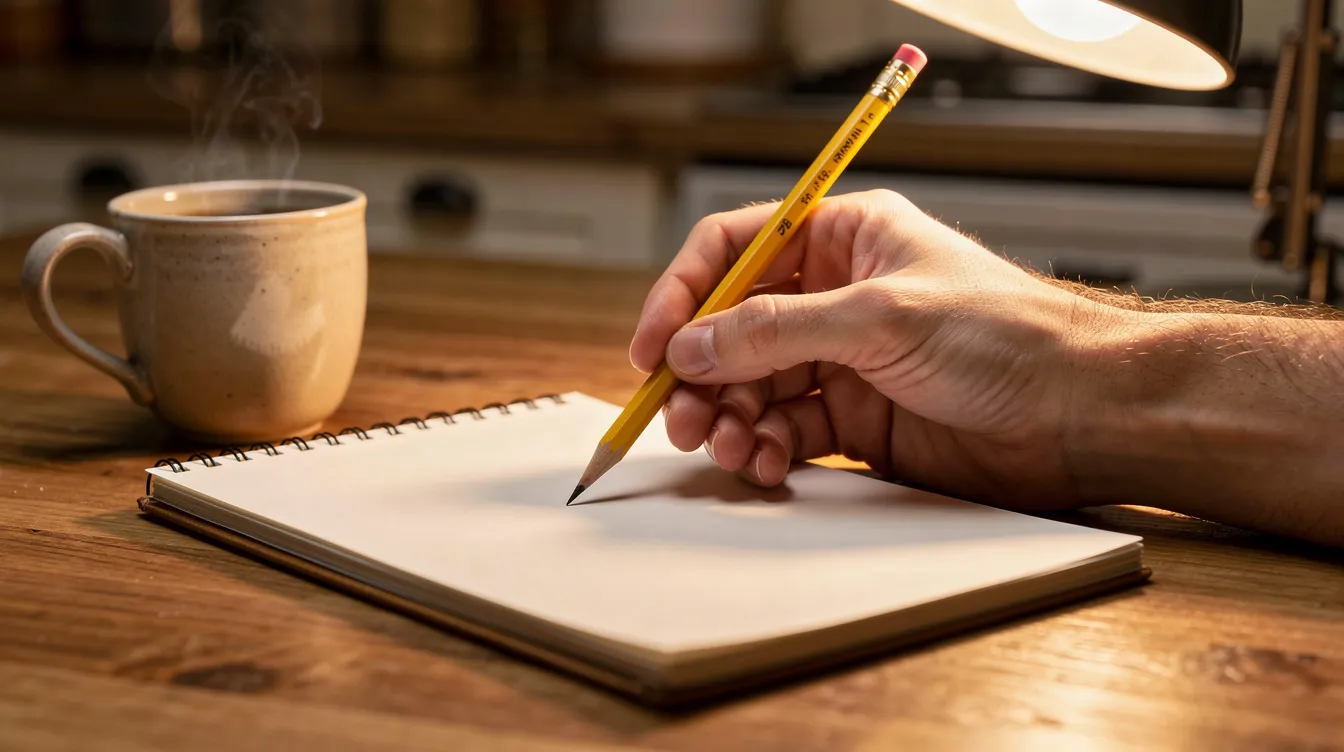
I stopped drawing for about fifteen years. When I picked a pencil up again my hand remembered less than I hoped and my eye remembered more than I wanted. Every wobbly line looked wrong to me because I had spent a decade and a half looking at finished illustrations, photographs, and paintings without putting a single mark on paper myself. My taste had kept growing while my skill had stayed frozen somewhere around age twenty.
That gap between what I could see and what I could draw is the real difficulty of learning to draw as an adult. It is not that the brain slows down, or that the hand forgets for good, or that some window of artistic talent closes at eighteen. Adults can learn to draw at any age. The process is not harder in any way that matters for a hobbyist, but it feels different because you notice every flaw.
This article covers what I have learned since I started drawing again: basic shapes and why they matter, how to practice drawing when your free time is short, how to draw people and draw eyes without jumping ahead of your foundations, what to do with a pencil versus a tablet, and how to keep going when the results look nothing like the picture in your head. I write from my own experience and from what I have seen work for other adults at Sketching Again, where the focus is on sketching foundations and short, repeatable exercises. Nothing here requires art school, expensive supplies, or a full afternoon.
Can You Really Learn to Draw as an Adult?
Yes. A randomized controlled trial tested observational drawing training with participants aged 65 to 87. After roughly ten online lessons plus daily practice, the group showed drawing skill gains with an effect size of d = 1.27, which is well above what researchers consider a large change. These were people who had not drawn in decades, and many had never drawn formally at all.
Your brain does not stop adapting when you leave school. A separate study found that art students taking an introductory drawing course showed reorganization in their white matter (prefrontal regions) and improved in sketching the human figure from observation over three months. Gray matter changes in motor and visual cortices have been measured within four weeks of focused drawing practice in adults. The brain reshapes itself around what you repeatedly do, whether you are twenty-five or seventy.
The difference between an adult beginner and a child beginner is not capacity. It is expectations. A six-year-old draws a face and shows it to everyone in the room. An adult draws a face, compares it to a portrait by a professional artist, and puts the sketchbook away. The real difficulty of this drawing journey is not motor control or memorizing proportions. It is living with the gap between your taste and your current skill level long enough for the skill to catch up. Most of what follows in this article is about how to do that.
Talent vs Practice: Rethinking “Artistic Talent”
When most people say someone has natural talent, they mean the person drew well early, without visible effort. What they usually do not see is the hundreds of hours that person spent drawing as a child, the parent who left paper and pencils out, or the curiosity that kept them sketching while other kids moved on to something else. Artistic talent, in nearly every case I have looked at, is a mix of early exposure, curiosity, and persistence.
Adults carry something a child beginner never has: strong opinions about their own work. I could see that my circle was lopsided, that my shading was patchy, that my proportions were off. A child the same number of hours into learning would not notice those things, and that child would keep going. Adults mistake the ability to see errors for a lack of talent, when it is actually evidence of a well-trained eye.
Research supports this. In a study of art students, baseline creativity scores (measured by standardized tests) did not predict who improved most. What predicted improvement was doing the work. In a separate engineering education trial, students with low initial spatial visualization scores made some of the largest proportional gains when given structured freehand sketching practice. Starting behind did not limit how far they moved.
Here is a concrete comparison: an “average” adult who practices one focused hour a day for a year accumulates roughly 365 hours of deliberate drawing. A “talented” person who draws sporadically, say two hours a week, accumulates about 104 hours. By the end of that year, the steady learner has more than three times the practice volume. Natural talent might speed early progress by 10 to 20%, but consistent practice decides where you end up. I also find that repeating exercises that feel dull is easier as an adult because I understand why I am doing it. Each page of ellipses drawn from the shoulder is not busywork; it is the thing that makes the next real drawing better.
How Long Does It Take To Learn to Draw as an Adult?
Estimates from structured learning programs converge on a rough scale. About 50 hours of focused practice produces visible improvement. About 500 hours gets most people to a point where they can draw convincingly from life. Professional-level illustration may take 2,500 to 8,000 hours depending on the field.
For someone practicing 20 to 30 minutes a day, five days a week, 50 hours arrives in roughly five to six weeks. My own data point is smaller: twenty minutes, three or four times a week, and I could see real change in my line confidence and shape construction after about two months.
Concrete milestones in the learning process tend to follow a pattern. After about one month of regular practice, you get better line control, recognizable ellipses and simple cubes, and fewer completely wrong proportions. After three months, you can draw a basic still life with shading and light, and rough attempts at simple portraits or hands. After six months, gesture drawing and combining shapes into figures start to feel natural. After a year, you depend less on reference for proportions and start to find your own way of working.
These milestones assume you practice regularly, at least three to five times a week, with sessions of at least 15 to 20 minutes. Daily practice of even 10 to 15 minutes improves drawing skills more effectively than a rare long session. The learning process looks like a staircase, not a smooth ramp. There are flat patches every few weeks where nothing seems to change, then a sudden jump. When I hit a plateau, I shrink the task: one pear for twenty minutes, or I swap the pencil for a ballpoint pen so I cannot fuss over corrections. The constraint forces me to stay focused on observation rather than perfection.
Getting Ready: Internal Preparation for Learning to Draw
Before you pick up a pencil, write down why you want to learn how to draw. Not a grand statement, just a line or two. Relaxation after work. Sketching on a trip next year. Drawing the dog. Returning to something you used to love. The reason matters because it is what pulls you back to the sketchbook on a tired Wednesday evening.
Set one or two goals you can check against. “Draw in a sketchbook at least four days a week for the next 90 days” is checkable. “Get good at drawing” is not. The creative process improves when you give it a container.
Address the fears now, because they do not go away on their own. Most adults compare a first sketch with finished work they have admired for years. That comparison is unfair but automatic. Perfectionism, fear of embarrassment, the feeling of starting behind; these are real, and they fade only with evidence that you are moving. Expectations influence drawing success across different ages, and adults who expect perfection on day one quit fastest.
Write the date on a blank page. List three doubts (mine were “I am too old,” “I have no artistic talent,” and “this is a waste of time”) and three things you are curious to draw. Keep that page. You will look at it later and most of the doubts will seem smaller. One thing that is easier for adults: I can sit with one object for twenty minutes without wandering off, which I could not have done at sixteen. That patience is an advantage. Use it.
External Preparation: Tools, Space, and Sketchbook Setup
Here is what I actually started with: plain copy paper and a box of ordinary HB pencils. I bought too many supplies anyway, when a pencil, paper, and a basic eraser were enough for months. Basic drawing supplies do not need to be expensive to start learning. Use a simple set of graphite pencils to begin: an HB and a 2B cover most early needs. A kneaded eraser is useful for lifting graphite without damaging paper, and a cheap white eraser handles crisper corrections. A sharpener. That is the list.
Gather essential supplies like paper and an eraser, and resist the urge to buy a beautiful sketchbook right away. Expensive sketchbooks intimidate adult beginners because every page feels precious. Cheap paper gave me permission to make bad drawings, which are the raw material of improvement. If you do buy a nice sketchbook, give the first few pages away on purpose: date one, do a messy test, and move on. The sketchbook’s job is to hold your practice, not to be a gallery.
My drawing space was the kitchen table after dinner. Decent light (a desk lamp angled from the left if you are right-handed), a comfortable chair, and a board or large book to tilt the paper slightly toward you. You can experiment with different materials later, but right now the point is to reduce friction. If the setup takes longer than two minutes, you will skip sessions.
I focus on sketching at Sketching Again, so I encourage having a dedicated “everyday sketching kit” that can travel: a small sketchbook, a mechanical pencil, a pen. Keep it in your bag or by the door. The kit should be so simple that forgetting it is hard.
First Steps: Warming Up and Hand-Eye Coordination
Warm ups matter more for adults who spend hours gripping a mouse or typing. Stiff wrists and tight shoulders produce cramped, hesitant lines. Older adults may face physical challenges affecting drawing, and a few minutes of loosening up at the start of a session prevents strain and builds the muscle memory that makes drawing lines feel natural over time.
Warm-up exercises improve hand-eye coordination for drawing. Here is what I do for five to ten minutes before I draw anything real: one page of straight lines drawn in a single confident stroke from one side of the paper to the other, using the shoulder rather than the wrist. Then a page of curved lines, circles, ovals, and figure eights, also from the shoulder. Engaging the shoulder rather than the wrist enhances drawing fluidity and gives you smoother, longer marks. The lines will wobble. That is fine. The goal is movement, not perfection.
These are not childish doodles. They are coordination training. Practicing basic line and shape exercises builds a strong foundation for drawing, and I still do a half-page of warm ups before every session. For the first month, fill one full page of warm ups at the start of each sitting, then adjust based on how loose you feel.
If you want one thing to try tonight, here it is: set a timer for five minutes. Draw straight lines, then circles, then ovals, all from the shoulder, covering one page. Do not try to make them perfect. Just move your arm. That is a good drawing exercise for getting started again, and it is deliberately plain so you cannot judge it as art.
Building Foundations: Seeing and Using Basic Shapes
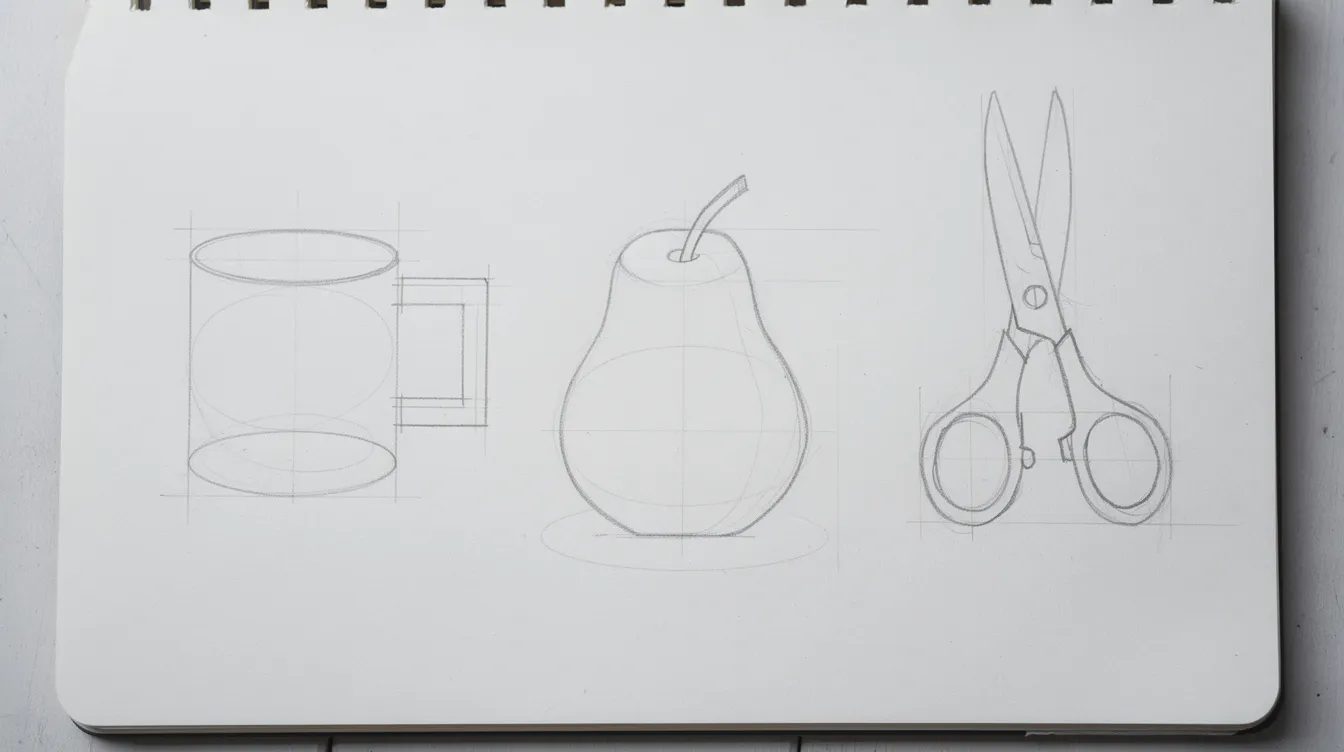
Start with basic shapes like circles, squares, rectangles, and triangles. These are the core of the learning process because every object you will ever draw is made of geometric shapes combined and distorted. A circle becomes a sphere. A rectangle becomes a cylinder. A triangle becomes a cone. Basic shapes can simplify complex subjects in drawing, from a coffee mug to the human body.
My first subjects were a mug, scissors, a pear, and my left hand. The lesson from the mug: it is not a perfect ellipse with a handle. It is a slightly lopsided shape that leans, and noticing the lean is the skill. Practice drawing basic shapes like circles and rectangles until they become second nature, then break common objects into those simple shapes. A chair is a set of rectangular prisms. A potted plant is a cylinder (pot) topped with a rough sphere (leaves). Learning to draw objects this way means you can draw anything if you can see what shapes it is made of.
Spend a week drawing only boxes and cylinders from different angles, then combine them into household objects. This exercise builds your understanding of perspective and teaches you to draw realistically by constructing form rather than copying outlines. Drawing involves observation, hand-eye coordination, and understanding shapes, and this is where all three come together.
Learning to See Like an Artist
“Seeing like an artist” means noticing angles, proportions, and negative space rather than relying on symbols stored in the mind. Adults often visualize and draw symbols instead of actual shapes. You draw an eye as an almond because that is the symbol you learned decades ago, not because the eye in front of you looks like an almond. Drawing from life trains the thing adults most need: looking at what is actually there rather than what they assume is there. Relying on memory can hinder drawing accuracy, so observation from real life improves your proportions and shading.
Try a simple angle-measuring exercise. Hold a pencil at arm’s length to compare the tilt of a window frame or a lamp, then match that angle on paper. This trains you to see angles as they are, not as you expect them to be.
Blind contour drawing helps develop observation and coordination. Slowly trace the edge of an object with your eyes while drawing a continuous line without looking at the paper. The result will look strange, wobbly, nothing like a finished drawing. That is the point. contour drawing is an old teaching method that forces the connection between eye and hand, and the odd lines are fine.
Build a daily routine: five minutes of slow contour drawing of a single object from real life, such as a spoon, a shoe, or a houseplant. Draw from real life to improve proportions and shading. This is something you can do tonight, with whatever is on the table in front of you, and it is one of the fastest ways to improve your observation of the natural world.
Structuring Your Practice: A Simple Adult-Friendly Plan
A realistic weekly structure for a busy adult might look like four 30-minute sessions plus one 60-minute weekend session. My own version is smaller: a twenty-minute timer, three evenings a week. That small routine survived busy weeks when the grand plan in my head never did. Consistent short practice sessions improve drawing skills more effectively than long, rare ones.
Divide each session into three parts. Five minutes of warm ups (lines, shapes). Ten minutes of focused exercise (basic shapes, value scales, or gesture drawing). Five minutes of a “fun drawing” of anything you like. The fun part matters; it keeps the whole thing from feeling like homework.
Here is my sample week. Monday: contour drawing of one household object. Wednesday: shading ramps from light to dark, then a shaded sphere or egg, because the study of light and shadow is crucial for realistic renderings and shading techniques are essential for creating three-dimensional effects. Experiment with different shading techniques like cross-hatching to understand how darker areas build form. Friday: quick sketches of gesture (timed two-minute poses from an online reference), then one slower drawing. Optional weekend: look back through the week’s pages and circle one thing that worked. Repeating the same few exercises lets you see progress because the task stays the same and only you change. If you want a starting list, I keep a set of sketch exercises worth repeating on hand for exactly these sessions.
For a 30-day plan: Weeks 1 and 2 focus on basic shapes and simple still lifes. Weeks 3 and 4 introduce simple figures and facial features. Date every sketchbook page. Use light lines for initial sketches to refine later, and do not erase the construction. Practice drawing every day for at least 10 to 15 minutes, even if the session is short.
From Simple Objects to Drawing People
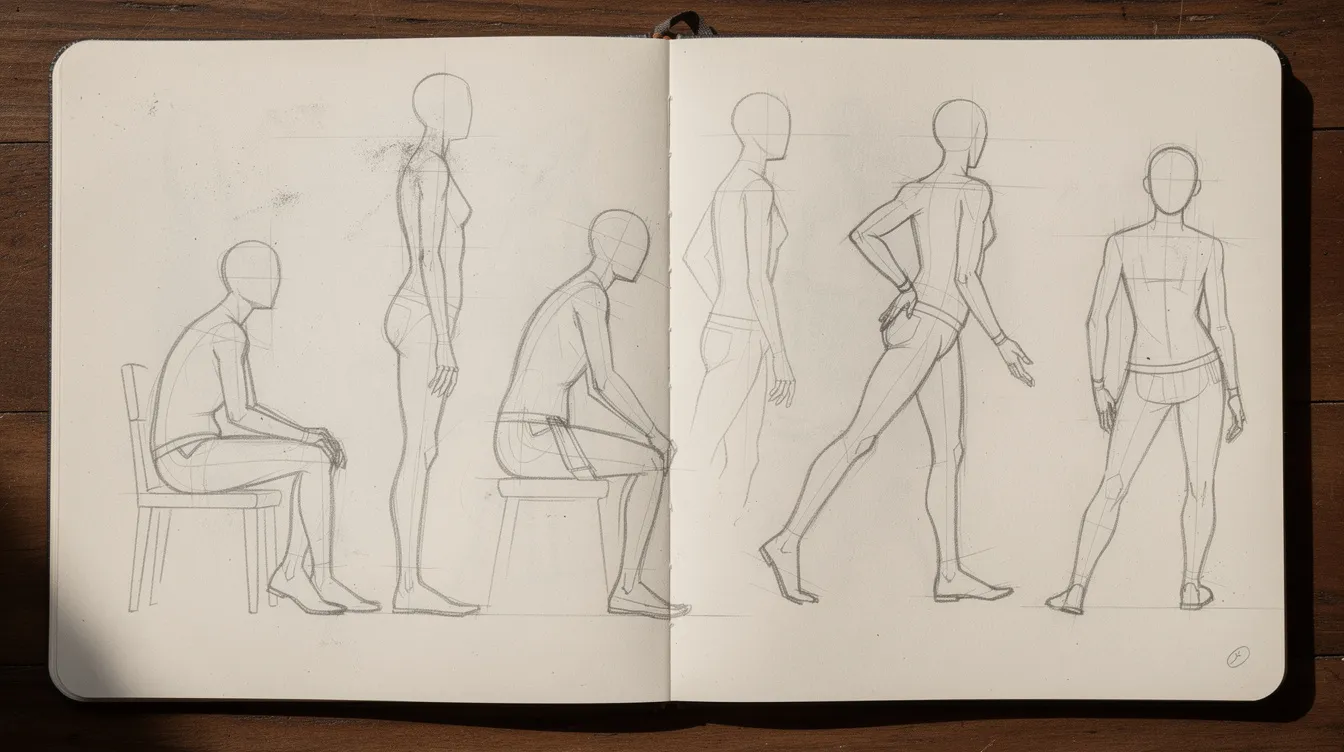
The progression works best in order: draw objects first, then simplified figures built from sticks and basic shapes, then gradually add volume and anatomy. Trying to draw people before you can draw a cylinder is like trying to write sentences before you know the alphabet. The human body is a collection of cylinders, spheres, and tapered forms, and if you can draw those, you can build a figure.
Start with simple mannequins: cylinders for limbs, a box for the torso, a sphere for the head. Draw them in basic poses: walking, sitting at a desk, reaching for a cup. The average adult figure is roughly 7 to 8 heads tall, though accuracy comes with practice and no one measures heads on a subway sketch. Gesture drawing, short timed sketches of 1 to 2 minutes, trains you to capture movement, weight, and posture. Draw fellow artists, commuters, coworkers, or family members. Quick sketches in a waiting room or on a bus build figure drawing skill faster than careful copying from a photograph because the subject moves and you must decide what matters.
Focusing on Features: Learning to Draw Eyes and Faces
I wanted a portrait by week two and got frustrated. That was my mistake: jumping to faces before I could draw a convincing sphere. Objects first made everything later easier, because a head is a sphere with a jaw attached, and an eye is a smaller sphere sitting in a socket.
Here is a basic head construction. Start with a ball shape. Add a jaw by drawing a curved or angular form below it. Place a vertical central line and horizontal guides: one for the brow, one for the base of the nose, one for the mouth. The placement follows rough thirds of the lower face.
To draw eyes, think of them as spheres in sockets, not flat almond shapes. Upper and lower lids wrap around the form. Add simplified lashes and eyebrows only after the structure is clear. The study of light and shadow matters here: the upper lid usually casts a small shadow on the eyeball, and the brow ridge creates a shadow above the eye.
Dedicate one page a week to eyes from different angles and lighting. Use a mirror and real people as references as well as photos. Photos flatten depth, and drawing from real life improves your understanding of proportions and perspective in ways a flat image cannot.
Analog vs Digital Drawing: What Works Best for Adult Beginners?
For absolute beginners, I recommend pencil and paper for the first several weeks or months. This is my clear position at Sketching Again, and it ties back to the freedom that cheap paper gives you: permission to draw badly, which is where all learning starts.
Digital drawing introduces extra decisions that have nothing to do with drawing skill. Software menus, brush settings, layers, zooming, undo. Each one is a new skill on top of the new skill you are already trying to learn. The undo button in particular can become a crutch that hides the learning process from you, because you erase every wrong line before you can study it.
Digital becomes useful after you have basic control and confidence with lines and shapes. Once the fundamentals feel solid, a tablet can speed up iteration and let you explore new techniques without buying more supplies. A balanced approach: keep a physical sketchbook for daily practice and add short digital drawing sessions a few times a week once you are comfortable. Other artists working digitally from the start often develop strong software skills but weaker tonal control and less awareness of physical mark-making.
Common Adult Struggles and How to Handle Them
The first struggle is impatience. Adults expect a decent drawing by the second attempt because we are competent at other things. We can cook, drive, manage projects, and then we sit down to draw and produce something a child would tape to the fridge. The gap stings.
Comparing yourself with younger artists online, lack of free time, fear of “wasting” a nice sketchbook, slow progress, and harsh self-critique are all real. Mistakes are essential for learning and improving drawing skills. Every bad drawing teaches something if you look at it before you throw it away.
Here are concrete strategies. Set a 20-minute timer and stop when it rings, to stay focused without exhaustion. Treat practice pages as disposable. Share early work only with supportive fellow artists, not with the internet at large. For each drawing, note one thing you like and one thing to improve. I circle one thing that worked, which keeps me from noticing only mistakes and is part of why I kept going this time.
What I got wrong early: I erased constantly. Every wrong line disappeared before I could learn from it. Now I draw lightly, leave wrong lines in, and put a better one beside them. The eraser had been hiding my learning from me. Embrace discomfort as part of the learning process, and focus on growth rather than perfection during learning. Mistakes are part of the drawing learning process, and leaving them visible is how you track what changed.
One of my sketchbook pages from early 2023 has a lopsided portrait next to three attempts at the same eye, each slightly better. It is messy and none of the drawings are good. But the third eye is better than the first, and that page is more useful to me than any finished piece because it shows exactly where I was and where I was heading.
Developing Style Without Rushing It
Adults often want a recognizable style immediately, and chasing it too early slows down learning. Style is the visible trace of thousands of drawing decisions built over years, not a choice you make on day one. Your favorite artists did not pick a style from a menu; they drew so much that their habits, preferences, and quirks became visible.
Spend time copying artists working in styles you admire; it is study, not theft. Balance that with plenty of personal sketches so you do not become a clone. A rough ratio: about half your drawing time on fundamentals and half on subjects and looks you enjoy. Step outside your comfort zone regularly. Try a new subject, a different angle, or a technique you have never attempted. Style emerges naturally if you keep drawing and investigating what you love visually, and the creative process takes care of the rest.
Using Courses, Books, and Online Resources Wisely
There are more free resources, online tutorials, and courses for adult learners in 2026 than at any point in history. This abundance is a gift and a trap. The trap is spending every weekend watching a different teacher without giving any single method long enough to work.
Choose one structured path and follow it for 2 to 3 months. A foundational course such as a Sketching Again fundamentals series, or one carefully chosen book. Utilizing structured tutorials can accelerate the learning process for beginners, but only if you do the exercises. My rule: for every hour watching or reading, spend at least two hours with a pencil in hand. I rotate through a few exercises I know work rather than collecting more. That keeps me drawing instead of browsing, and it matches my learning style better than constant novelty.
Sketching Again is built around this idea: calm, structured, repeatable lessons made for adults who want to learn drawing without wading through thousands of scattered videos. If that sounds useful, it is here when you are ready.
Tracking Progress and Staying Motivated Over the Long Term
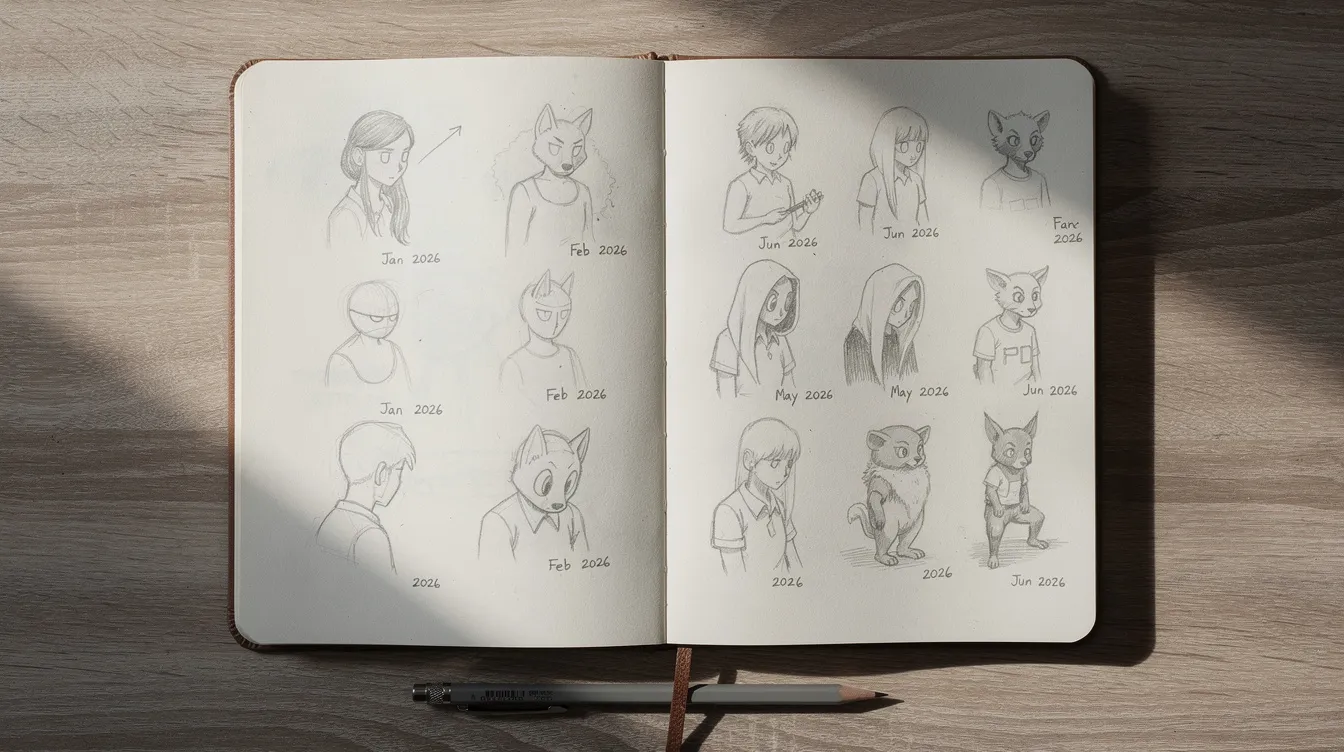
Date everything. Keep your sketchbooks in order. Using a sketchbook helps track progress and practice regularly, and the dates turn it into a record you can flip through. After a couple of months I flipped back to my first week and the difference was obvious in a way it never is day to day. Regular practice leads to improvement over time, and the dated pages prove it.
Once a month, flip through the last 30 days. Choose three favorites. Note what improved since the previous month. Adults juggling work and family need small celebrations and visible proof, because the daily grind makes progress invisible.
Redraw an earlier subject, a self-portrait or a favorite object, exactly one year later to compare skill level and refine goals. The before-and-after is the most honest measure of where you are.
Pull out old sketchbooks from years ago if you have them. Some of my pages were embarrassing and a few were better than I remembered, and both were useful. The embarrassing ones showed how far I had come. The better ones showed what I was drawn to before I started second-guessing myself, and that is a clue about where to take your art next.
Final Thoughts
Learning to draw as an adult is possible, deeply satisfying, and changes how you see the world. A coffee cup stops being invisible. A tree outside the window has a specific shape you never noticed. You start paying attention to detail in everything around you, not just on paper.
You do not need extraordinary artistic talent. You need basic shapes, observation, regular practice, and patience with the process. Learning to draw requires practice and patience at any age, and the right mindset is simply the willingness to keep going when the results are not what you hoped.
Take one small step today. Fill one page with basic shapes, or draw one object in your kitchen in twenty minutes, rather than waiting for a “perfect” free day. The most important thing is to start drawing. If you want structured support, Sketching Again has step-by-step sketching lessons and drawing tips made for adult learners who want to learn to draw without pretending they are eighteen again. Pick up a pencil tonight. Set a timer. Draw what is in front of you. That first page is the start of a long, creative chapter, and the fun is in the drawing, not in the finishing.
FAQ
Is it too late to start learning to draw as an adult?
No. Drawing is a new skill built through practice at any age. A controlled trial with participants aged 65 to 87 showed measurable drawing skill gains after structured practice. Adults often have more patience and a clearer reason for practising than they remember having when young.
How much time do I need each day?
Twenty minutes, a few times a week, was enough for me to see change over a couple of months. Even 10 to 15 minutes of daily practice produces improvement if the sessions are focused and consistent. Regular short sessions beat rare long ones.
What supplies do I really need?
An HB pencil, an eraser, and plain paper. Add a softer pencil such as a 4B once you start shading. A kneaded eraser is helpful for lifting graphite gently. Everything else can wait until you know what you actually need from experience, not from a shopping list.
Should I copy photos or draw from life?
I mix both but lean on real objects because they teach careful looking. Drawing from real life enhances understanding of proportions and perspective. Photos help when a subject will not hold still, though they flatten depth and remove some of what you would otherwise notice about the natural world.
What do I do with my old sketchbooks?
Keep them. I reread mine, noted what I used to enjoy drawing, and reused a few of the better ideas. Old pages are a starting point, not a verdict on your ability. They show what you cared about before the doubt crept in, and that is worth knowing.
